33 million people.
That is how many people were affected by Pakistan’s 2022 floods. More than 8 million were displaced, and the disaster caused about $30 billion in damage and economic losses. The World Bank-led Post-Disaster Needs Assessment estimated more than $14.9 billion in physical damages alone. (World Bank)
Pakistan also has a remarkably small share of global emissions relative to its exposure to climate shocks: the World Bank describes its contribution as less than 1% of global greenhouse-gas emissions. (World Bank)
So the country’s climate problem is not theoretical. The difficult question is what happens after a climate policy is announced.
Pakistan has ambitious targets, large environmental programmes and international climate partnerships. Some are producing measurable progress. Others have gaps between what was planned and what was delivered. In several areas, the public evidence is still too weak to determine the long-term outcome.
That distinction is the part of climate policy that gets overlooked.
A target is not an outcome. A planting count is not a surviving forest. A renewable-energy target is not the same thing as reliable clean electricity. And a protected area on a map is not automatically a protected ecosystem.
This article uses one standard throughout: what was promised, what was funded, what was implemented, and what changed as a result?
Start with the policy, then follow the evidence
Pakistan has built a substantial climate-policy framework, including the National Climate Change Policy 2021, National Adaptation Plan 2023, National Clean Air Policy 2023, and its Nationally Determined Contributions under the Paris Agreement.
The existence of those documents matters. But policy documents are plans, not proof of impact.
A 2024 peer-reviewed study of climate-policy implementation in Pakistan identified problems including fragmented governance, weak coordination across levels of government, unclear responsibilities and insufficient integration of local actors. (Environmental Policy and Governance)
Pakistan’s reporting to the UNFCCC has also highlighted the importance of additional finance, technology transfer and institutional capacity for meeting its climate targets. (Pakistan’s NDC 3.0)
That does not prove that Pakistan’s climate policy has failed.
It establishes something more useful: implementation is a separate research question from policy design.
The right question is therefore not simply, “What did the government announce?”
It is:
What measurable change followed the announcement?
1. The Ten Billion Tree Tsunami: the numbers are more complicated than the slogan
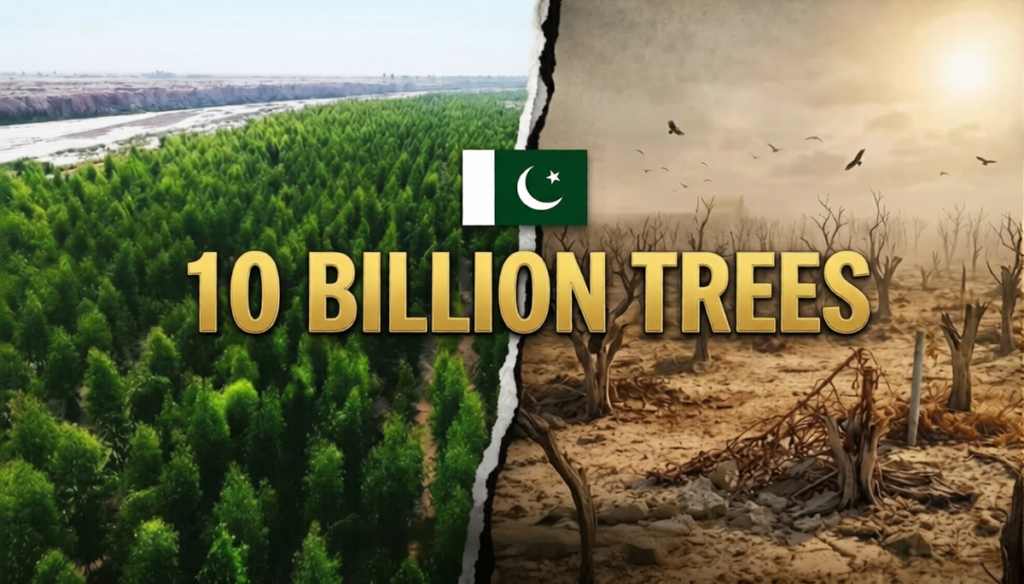
The Ten Billion Tree Tsunami Programme (TBTTP) is one of Pakistan’s most visible environmental programmes. Its headline target is easy to understand: plant or regenerate billions of trees across the country.
But the first serious evaluation problem appears immediately:
What exactly are we counting?
Official government reporting recorded 326.316 million plants planted or regenerated in 2019–20, alongside 341.433 million plants raised in nurseries. (Government of Pakistan)
Those are legitimate programme outputs. They are not, by themselves, evidence of long-term forest restoration.
The distinction became especially important when Pakistan’s Auditor General later reported that, for the 2019–2023 period, the programme had a target of 3.296 billion plants but 2.069 billion were recorded as actually planted. (Auditor General of Pakistan)
That is a measurable implementation gap: roughly 63% of the stated target was recorded as planted in that audit period.
But even that number is not the final environmental outcome.
The next questions are harder:
- How many plants survived?
- Which species survived?
- Where were they planted?
- Did they restore native ecosystems or create plantations?
- What change occurred in forest cover, biodiversity, soil or watershed function?
- What carbon benefit can actually be attributed to the programme?
There is an important nuance here. Pakistan did commission independent third-party monitoring involving IUCN Pakistan, FAO and WWF-Pakistan for selected sites. (TBTTP preliminary assessment)
So the accurate criticism is not “nobody checked the programme.”
The stronger criticism is narrower: public debate still tends to focus on planting totals, while the policy-relevant question is whether those interventions produced durable ecological outcomes at scale.
That is the metric worth demanding.
2. Renewable energy: Pakistan has made progress, but the target is still unfinished
This is an area where outdated statistics can create a misleading picture.
Pakistan’s 2021 NDC committed the country to 60% renewable energy in the national energy mix by 2030. According to the country’s latest NDC reporting, the renewable share had reached 35.2% by 2025. (Pakistan’s NDC 3.0)
That means the correct story is not “Pakistan has done nothing.”
Pakistan has moved substantially toward its target.
The remaining question is whether the country can close the gap without creating new problems in reliability, affordability and transmission.
For climate policy, installed renewable capacity and actual electricity-system performance are not identical measures. A national transition ultimately depends on the electricity that can be generated, transmitted and delivered when people and businesses need it.
That makes several indicators more informative than a single percentage:
Capacity: How much renewable generation has been built?
Generation: How much electricity does it actually produce?
Grid: Can the transmission and distribution system absorb it reliably?
Cost: Who pays for the investment, and who receives the savings?
Emissions: Is fossil-fuel generation actually falling?
These questions also matter at household level. Rooftop solar can be financially attractive for households that can afford the upfront investment, but the benefits are not automatically equal across income groups.
So the climate-policy question is not merely “How quickly can Pakistan add solar?”
It is also “How do we build a cleaner electricity system that ordinary households can actually access and afford?”
3. Protected areas: designation is an input, not the outcome
Protected areas are another case where a headline number can hide the real policy question.
Declaring land protected can create a legal framework for conservation. It does not guarantee effective enforcement, healthy ecosystems or benefits for the people who live nearby.
Pakistan’s National Climate Change Policy includes biodiversity conservation, ecosystem restoration, protected areas and community participation as parts of its environmental strategy.
That community element matters because conservation happens in places with existing livelihoods, land-use patterns and local knowledge.
The strongest version of protected-area policy therefore has to answer more than one question:
Biodiversity: Are species and habitats actually improving?
Enforcement: Are the rules being enforced on the ground?
Livelihoods: What happens to people whose access to land or natural resources changes?
Local participation: Do communities have a meaningful role in management and benefit from conservation where appropriate?
A protected area that exists only as a boundary on a government map is a policy input. A protected ecosystem with measurable ecological improvement is a policy outcome.
Those are not the same thing.
The deeper problem: implementation capacity
It is tempting to reduce all of this to “government failure.” The evidence is more complicated.
Pakistan’s climate policies cut across federal and provincial institutions and sectors ranging from agriculture and water to energy, forestry, transport and disaster management. The peer-reviewed implementation research on Pakistan specifically identifies coordination and institutional fragmentation as major barriers. (Environmental Policy and Governance)
Climate policy is therefore partly a governance problem.
A technically good policy can perform badly if responsibilities are unclear, money arrives late, local institutions lack capacity, or monitoring stops at the project’s output stage.
This also explains why two apparently contradictory statements can both be true:
Pakistan has ambitious climate policies.
and
Pakistan has serious climate-policy implementation weaknesses.
The first describes policy design.
The second describes delivery.
Confusing those categories is how public debate turns into either automatic praise or automatic cynicism.
And yes, governments should be evaluated by results rather than by how impressive an announcement sounds. Appreciation is not a climate-policy metric.
Climate finance changes what is possible
Pakistan cannot treat climate adaptation and decarbonisation as cheap side projects.
A 2025 UN Pakistan assessment, drawing on World Bank estimates, put the investment requirement for a comprehensive climate response through 2030 at approximately $348 billion: about $152 billion for adaptation and resilience and $196 billion for decarbonisation. (United Nations in Pakistan)
The same assessment identified limited institutional capacity, slow disbursement and reliance on debt-based climate finance as important constraints.
That changes the international-partnership question.
The sensible question is not whether foreign climate finance is inherently good or bad.
It is whether the money produces durable public value.
For a major externally financed project, the public should be able to ask:
- How much was promised?
- How much was actually disbursed?
- What was the original objective?
- What measurable output was delivered?
- What outcome was achieved?
- Who maintains the project after donor funding ends?
- What local institutions and skills remain afterward?
In other words, follow the money and then follow the outcome.
A practical scorecard for any Pakistani climate project
The most useful thing citizens, journalists and researchers can do is stop treating all climate claims as the same type of claim.
Use this chain:
Promise → Funding → Implementation → Output → Outcome → Long-term impact
Take a tree programme.
Promise: Restore forests and increase tree cover.
Funding: How much was allocated, and how much was released?
Implementation: How many plants were actually planted or regenerated?
Output: How many survived and where?
Outcome: Did forest condition, biodiversity, soil or watershed function improve?
Long-term impact: Did resilience or carbon storage measurably improve?
Now apply the same test to renewable energy.
Promise: Reach 60% renewable energy by 2030.
Funding: What investment is available?
Implementation: How much renewable capacity was added?
Output: How much electricity is actually generated?
Outcome: Is fossil-fuel generation declining?
Long-term impact: Are emissions falling while electricity remains reliable and affordable?
This framework has one major advantage: it works whether the programme is succeeding or failing.
It does not begin with a political conclusion.
It begins with a measurement problem.
What should citizens ask for?
You do not need to be a climate scientist to demand better evidence.
Ask for five things.
1. A baseline
What was the situation before the project began?
Without a baseline, “improvement” can become a slogan.
2. A measurable target
What exactly was supposed to change?
“Build resilience” is difficult to audit. A quantified target with a deadline is much easier.
3. Independent verification
Who checked the numbers?
Government data are indispensable, but external audits, satellite measurements, field surveys and independent evaluations can make programme claims much easier to trust.
4. Geographic breakdowns
Pakistan is not one climate environment.
Flood risk in Sindh, water stress in Balochistan, glacier-related hazards in the north and urban heat in major cities require different interventions and different success measures.
5. Long-term monitoring
A project can meet its first-year output target and still fail its five-year objective.
That is why climate accountability should continue after the inauguration ceremony.
What can individuals actually do?
Individual action is useful, but it should not be confused with institutional action.
You cannot replace a national electricity policy with one rooftop solar system. You cannot replace watershed management by planting one tree. And you cannot compensate for weak public monitoring simply by recycling at home.
What individuals can do is improve the demand for evidence.
Five minutes
Follow Pakistani researchers, universities, environmental institutions and credible local reporting on climate policy.
Thirty minutes
Pick one climate project in your district and find four answers:
- Who funds it?
- Who implements it?
- What was promised?
- What evidence shows that anything changed?
More time or money
Support credible local conservation, environmental education, community resilience or evidence-based advocacy. Where household investments such as solar or water-saving systems make economic sense, evaluate them on their actual costs and benefits rather than treating them as automatic climate solutions.
The point is not to make every citizen a climate activist.
The point is to make climate claims easier to verify.
The reality no one should ignore
Pakistan’s climate policy is neither a complete success story nor a story of total failure.
The evidence shows real programmes, real spending and real progress alongside implementation gaps, financing constraints and weak evidence for some long-term outcomes.
The Ten Billion Tree Tsunami illustrates the distinction perfectly: there are substantial reported planting figures, an audited implementation gap against targets, and third-party monitoring of selected sites. But the number that ultimately matters for climate and ecology is not the number of saplings announced. It is the durable environmental change that survives years after planting.
Renewable energy shows the other side of the picture. Pakistan reported a 35.2% renewable share by 2025 against a 60% 2030 target. That is measurable progress. It is also an unfinished transition.
The same logic applies everywhere.
Do not ask only whether Pakistan has a climate policy.
Ask whether it was funded.
Ask whether it was implemented.
Ask what changed.
And, most importantly, ask whether the change lasted.
That is the difference between a climate policy on paper and a climate policy that works.
Related Reading
Green IT in Pakistan: Building a Sustainable Digital Future

